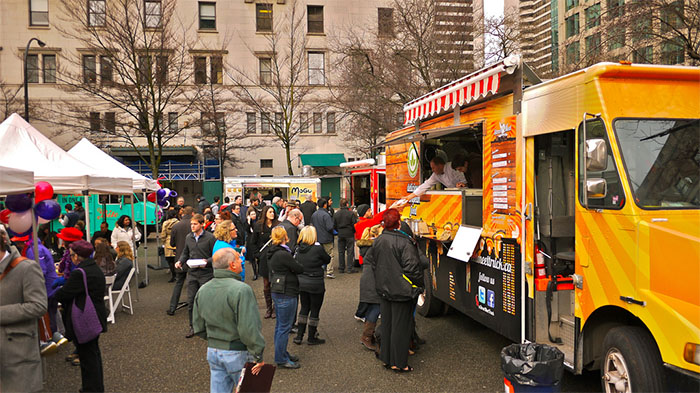
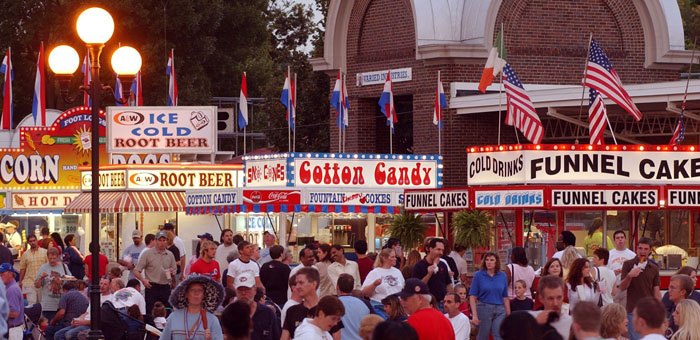
Food truck owners are consistently looking for new venues to increase the coverage of their sales. Festival season is right around the corner so why not become a mobile concession stand vendor? This article is designed to help those food truck operators that have yet to investigate the world of festivals. It will also help those who have given it a go, but selected the wrong festivals to participate in.
Preparations for the prime event season, (Memorial Day to around Labor Day), must focus heavily on the type of events or venues that you decide to pursue. There are many options to choose from. Generally, the events that will take place in your area fall into two categories: local events and large events.
Page Contents
Event Size
Local Events
Local events usually represent a local organization or a celebration that involves one or two cities. The size of these events may not necessarily dictate smaller revenue. On the contrary, they can be great sources of profit. Close-knit communities tend to want to put money back into their town and support the mobile concession stand vendors involved. Smaller events also generally have lower space fees for their lots because the production cost is lower.
A potential pitfall of smaller, local events is the general state of the community. For example, if one of the larger companies in the city shuts down, this can affect the attendance of the event as well as the money a mobile concession stand vendor may make.
Large Events
Larger events, such as state or county run events are held over a period of several days. This can mean big bucks in revenue since you will have a steady stream of new, captive customers every day. The potential for sales upwards of $30,000 in one weekend is not unheard of.
The reason these events are not as desirable is the level of difficulty it can take to get a booth in the venue. Often times, the vendors that have been successful in years past are given preferential treatment with regards to first choice of participation and location. New mobile concession stand vendors with less experience will have a hard time breaking in to the big state events until they can prove that they will be able to handle the demands of a large event.
Another downside of the large events can be the charges associated with space fees. Larger venues tend to charge fees based on a percentage of gross sales. At some events this could mean a 25% cut of sales.
Attendance to Booth Ratio
When you are talking with event organizers, there are several important questions you will need to ask in order to determine the probable success of your food truck. The first is the estimated attendance of the event, or any past records, if the event has more than one year under its belt. This is a fairly standard question. The next set of questions will take a little more finesse. It involves finding out how much and what type of competition you will have.
- Determine the competition count. Determining exactly how many food vendors will be at the event will determine how much of a “cut” of the profits you will get when all is said and done.
- Discover the types of menus being sold. If you are able to find out what the menus of the competing vendors are going to be, you can determine if your truck will be more or less successful.
For example, say that you are able to find out that there will be ten food vendors at a small event. Six of them will be serving lunch and dinner items such as burgers, hot dogs and barbeque. Two of the vendors will be serving one or two specialty items such as kettle corn and elephant ears. One other vendor will be serving up espresso and other coffee drinks. If your food truck menu consists of primarily American style meal items, this not be a profitable event for you. However, if you sell snow cones or cupcakes, you could very likely make a killing.
- Find out booth locations. How the venue organizers assign booth locations could greatly affect your business at an event. If the areas are assigned on a first come, first served basis, and you get one of the first slots, you can choose the spot that will best suit you and your truck. If the venue assigns spots based on seniority, and you are a newcomer, it is likely you will not have prime placement in the space provided by the event.
Space Fees
Space fees are the rental fees you pay to the event or event organizers for the space that your mobile concession stand will occupy for the duration of the event. They range in prices depending on the size and relative popularity of the event. There are two types of fees: flat fees and percentage fees.
Flat Fees
A flat fee is exactly what it sounds like. You pay a fee up front to rent the space. The fee does not fluctuate depending on the success of the event. Typically the flat fee is charged based upon the frontage length, which in the case of the food truck would be the entire length of your vehicle from end to end. Flat fee events are almost always less expensive than events that have space fees based on percentages.
Percentage Fees
Larger events and events that are longer in duration and more established typically charge percentage fees. There is a deposit paid at the beginning of the event and at the end. Also, the vendor pays a percentage of his or her profits to the organization, minus the deposit. The fee is usually between ten to 25 percent.
For example: The event deposit for the event is $100 and the percentage is 15 and you make $5000 over the course of the event, then you would owe $650.
(5000 x 0.15)-100=650
While it is the most common form of charging for spaces, it is certainly not the most popular. Many vendors say that it does not take into consideration the overhead for running a business, such as food cost, utensils and packaging.
The benefit of having a space fee based on percentage of your sales is that, if sales are poor, you will not have as high of a space fee as you would if you were paying a flat rate.
What Events Work Best For Your Mobile Concession Stand
Event Length
It might seem like common sense that the longer the event, the more money you are likely to make. It is important to consider other factors about the length of the event or event where you are selling. There are typically three types of events: day-long, weekend and seasonal. Each type of event has its positives and its drawbacks.
- Day-Long. Day-long events are a gamble that can either pay off in a big way or cause an entire day to be wasted. If the event is extremely popular, you will have a steady stream of business all day. Also, since you will only be paying space fees for one day, you will get to keep a larger chunk of your profit. However, if the event is poorly attended, you will have wasted time, money and effort.
- Weekend. Weekend events are a popular choice for mobile concession stand vendors. They offer them the ability to spread their business out over the course of a few days. There is less risk associated with an event that is going to last three to four days. This is because if business is poor one day, there is always the chance to make up the difference over the course of the remaining days. However, space fees are usually much larger for weekend events, and they usually charge a percentage of the profits rather than a flat fee.
- Seasonal. Seasonal events such as Renaissance Festivals can be very profitable because they are heavily attended over the course of the entire season. The events are typically only open during the weekend, freeing up your weekdays for your regular stops. The seasonal events are typically well-established and is guaranteed work every weekend of the concession season. Because of the events’ maturity, it can be very difficult to get a space in a seasonal event.
It is important to remember the hours of operation these events will have as well as how long they last. If an event closes down around five in the evening and your menu revolves around dinner food, it is not going to be as profitable as a nighttime event
Location
It is important to consider where the event is being held. Some events are friendlier to food truck vendors than others with regard to accessibility and resources. An event that is located in a grassy park may be ideal for customers of the event. Unfortunately, it can be a logistical nightmare for vendors who have large trailers. Conversely, an event that takes place on the street makes it a piece of cake for a food truck to pull up and then set up and tear down quickly, and access to electricity is much easier if you choose not to use your own generator.
However, on a hot day, customers are likely to tire of the steamy pavement quickly and look for shelter elsewhere.
Admission Cost
Don’t forget that you won’t be the only business charging your customers money at the event. If the event is large, chances are, your potential customers have already shelled out money for entrance. If you are unable to make adjustments to the pricing of your menu items, stay away from larger venues that charge customers for entrance.
Event Age
The length of time and event has been around is a very important factor to consider.
- Choose established events for a sure thing. Events that have been around for a long period of time have an established customer base. They also provide consistency for food vendors. However, because of their reliability, they are able to charge more. This includes space fees and are much more difficult to get a contract with.
- Risk new events to reap rewards. New events or events are often eager to get new vendors signed on to their event and will charge much less. Just understand that since the event is unproven, there is some risk of poor attendance.
- Avoid poorly organized events. One of the other aspects of the maturity of an event can be the level of organization within the event. If the event is new or small, the committee in charge of keeping track of vendor relations can be extremely small and made up of volunteers.
RELATED: How Social Media Can Increase Your Food Truck Event Traffic
The Bottom Line
There are many factors when it comes to selecting the event and venues for your food truck. Finding that ideal spot requires you to know there will be some form of trial and error before you find the right fit. Use these tips for becoming a mobile concession stand as a guideline to help you to narrow down what you believe is the right mix.
Have you become a mobile concession stand vendor? What other tips do you have for those looking to make this change? Share your tips on social media. Facebook | Twitter